As this year’s contest draws to a close, we look back on the competitors. Thirteen teams registered last fall, coming from seven countries spanning four continents. We had six teams in Group A (virtual rig) and seven in Group B (physical rig). The effort proved too difficult for many teams, with only six submitting a Phase I Design Report. Two of the six were unable to complete their rig and withdrew in the spring.
The finalists competing for Phase II included:
Group A virtual test:
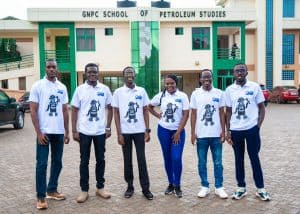
- University of Mines and Technology (UMaT) – Tarkwa, Ghana
- University of Stavanger (UiS) – Stavanger, Norway
Group B hybrid in-person and virtual test
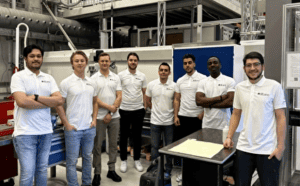
- Clausthal University of Technology (TUC) – Clausthal-Zellerfeld, Germany
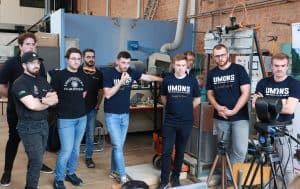
- Université de Mons (UMons) – Mons, Belgium
UMaT significantly improved their directional drilling model and user interface. They cleverly built a model that would automatically plot a course and build or turn in softer formations for increased overall ROP. UiS was the first team to take on the new well control option to detect and close in on a kick. They monitored flow in/out and pit levels and their model reduced false negative alerts.
The team from Germany traveled to Belgium to participate at Mons. Both Group B teams built and operated physical rigs to drill a directional well autonomously. As a first-time competitor, UMons focused on building a rig capable of a vertical well and were successful the first time out, which as we all know, is no small feat. TUC improved their miniature RSS by switching from a hydraulic controller to a mechanical one. Their work on the downhole tool, BHA and bit allowed up to 8 degree build in the small 1-1/2” hole, and they created an artificial magnetic field that was strong enough for detection by the downhole sensor.
The judges had a difficult time choosing between all of these excellent performers. The final selection has the University of Stavanger as the winner of Group A and the Clausthal University of Technology as the winner of Group B.
For the first time in the history of the competition, both winning teams will co-author the SPE paper to be presented at next year’s Drilling Conference. The paper will describe the efforts to design and build each teams’ work product and will look at their impact on automated drilling. In the future, these designs could be used to verify and validate the interoperability of various third-party apps that will be connected to full-scale rigs.
Let us all congratulate all the teams who participated this year, especially the finalists and the ultimate winners. Thanks to all the sponsors and volunteers who work in the background but are essential to making it all possible. We now look forward to next year.


